

For more than twenty years, search followed a predictable model: Google indexed web pages, people typed keywords, and the top-ranking link captured the click. That single channel has split into three distinct modalities: traditional search engines, real-time generative answer engines, and autonomous browser agents.
The traffic arriving at your site has shifted alongside these interfaces. Automated bot traffic now accounts for more than half of all public web requests. Teams that continue to measure digital performance solely through Googlebot crawl frequency and organic click-through rates are optimising for an audience that no longer represents the majority of web requests.
The Fragmentation of Search: Three Distinct Modalities
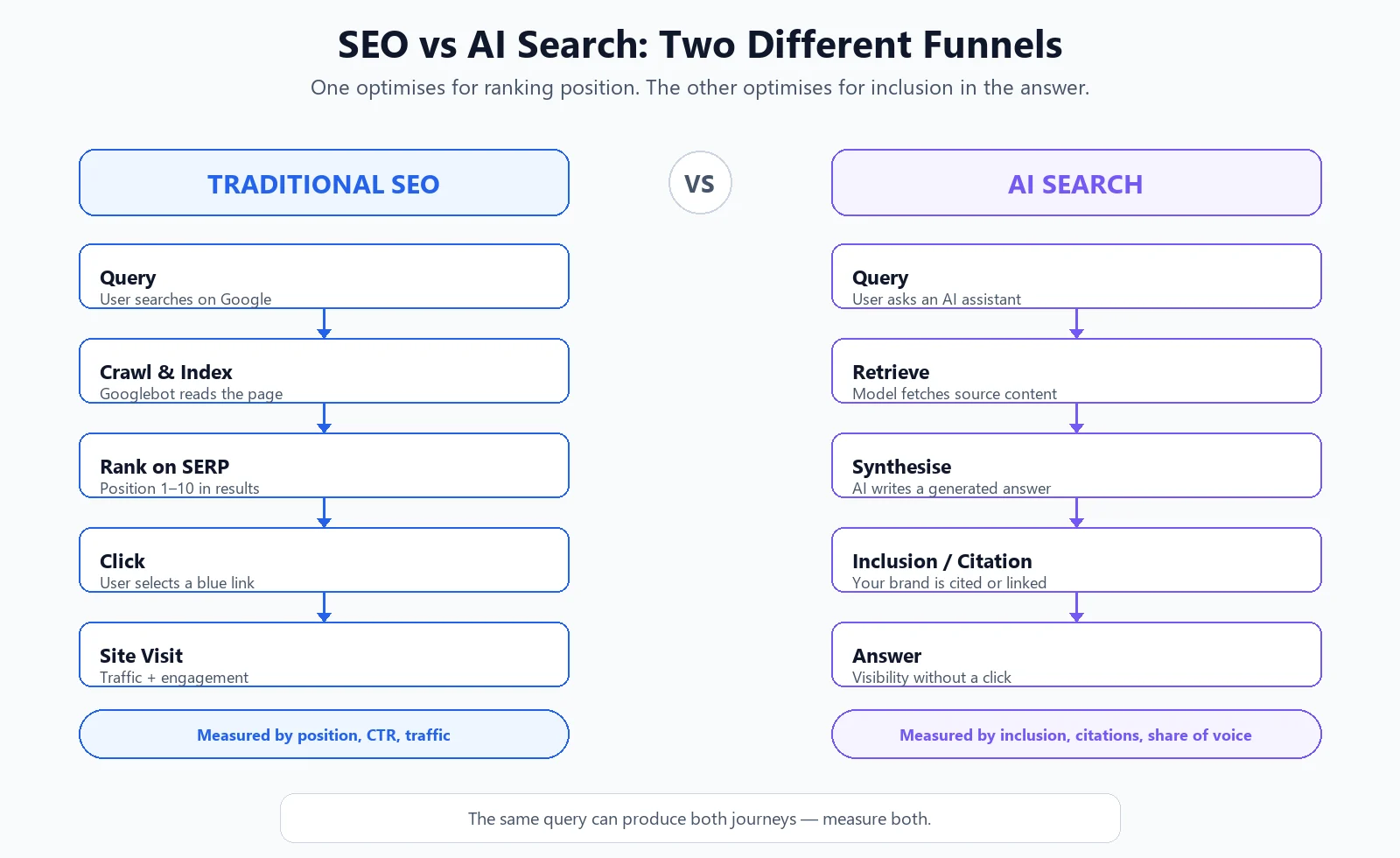
Search now operates across three distinct technical layers, each with its own retrieval mechanics and traffic dynamics:
- Classic search and information retrieval (Google and Bing): Spiders index full HTML documents, calculate link equity through PageRank, and return ranked lists of blue links.
- Generative answer engines and RAG pipelines (ChatGPT Search, Perplexity, Google AI Overviews): Retrieval-augmented generation systems query the live web at runtime, evaluate individual passages for semantic relevance, synthesise unified answers, and cite three or four supporting sources.
- Autonomous agent browsing and task execution (Anthropic Computer Use, OpenAI Operator, browser agents): Programs navigate the DOM directly, extract structured data, compare product specifications, and complete transactions on behalf of users.
Ranking first on Google no longer guarantees visibility in ChatGPT or Perplexity, nor does it ensure an agent can complete a checkout on your site. To evaluate how your site performs across these channels, review our enterprise GEO strategy services.
The Visitors to Your Website Have Changed
According to Cloudflare's Radar 2025 Year in Review and the HUMAN Security 2026 State of AI Traffic Benchmark (PDF Report), automated traffic surpassed human visitors on the public web in 2025:
- 51% vs 49%: Automated bot traffic outpaced human visitors across global web traffic in 2025.
- +305% year over year: GPTBot crawl volume expanded across monitored properties.
- +2,825% increase: ChatGPT-User requests (on-demand fetches triggered when a user prompts ChatGPT) grew rapidly.
- +157,490% increase: PerplexityBot request volume increased as real-time answer queries scaled.
Server access logs now record a wide variety of retrieval bots alongside Googlebot and Bingbot: GPTBot, ChatGPT-User, OAI-SearchBot, ClaudeBot, Claude-SearchBot, PerplexityBot, Meta-ExternalAgent, and cohere-ai.
The referral return from these crawlers differs sharply from traditional search engines:
- Google: Delivers roughly a 3:1 crawl-to-traffic ratio. For every three crawler visits, webmasters receive approximately one referral click.
- Perplexity: Operates at a 100:1 to 400:1 crawl-to-traffic ratio.
- OpenAI: Reaches a 3,700:1 crawl-to-traffic ratio.
- Anthropic: Operates between 25,000:1 and 100,000:1, occasionally reaching 500,000:1.
Google continues to deliver referral clicks in volume. AI platforms primarily retrieve content for model training and instant answer synthesis without generating a guaranteed visit. Managing how these bots access your content is a core business decision, not merely a robots.txt setting.
Agents Aren't Just Reading: They Are Transacting
Bot traffic is no longer limited to passive indexation. Autonomous agents now browse, evaluate, and execute actions within active web sessions.
The HUMAN Security 2026 benchmark report (PDF Download) shows where automated agent activity occurs across enterprise sites:
- 77.0% on product and search pages: Agents comparing product specifications, checking live inventory, and reading pricing tables.
- 8.8% on account pages: Agents operating within authenticated user accounts.
- 5.0% in authentication flows: Handling sign-ins and session handoffs for users.
- 2.3% on checkout pages: Completing purchases without human intervention.
If an ecommerce or SaaS application cannot be parsed by software agents, transactions fail silently. When an agent cannot extract pricing or interact with form controls, it routes the purchase to an accessible competitor. To test how easily agents navigate your site, see our agentic AI technical audit.
Why "It's Just SEO" Is a Risky Organizational Assumption
Every major web platform shift over the past fifteen years was initially treated as a routine SEO update:
- In 2012, responsive layouts and mobile indexing were called "just SEO".
- In 2016, conversational queries and voice search were called "just SEO".
- In 2017, Accelerated Mobile Pages (AMP) was called "just SEO".
- In 2025 and 2026, Generative Engine Optimisation (GEO) and Answer Engine Optimisation (AEO) receive the same label.
The technical requirements change with each shift, but organizational budgets and engineering allocations often lag behind user behaviour.
Treating AI search as identical to traditional SEO overlooks clear structural differences:
- Target audience: Traditional SEO targets a ranking algorithm and a human reader clicking a link. AI search targets a retrieval pipeline, a synthesis model, an autonomous browser agent, and a user reading a direct answer.
- Unit of optimisation: Traditional SEO evaluates the full HTML document. AI search evaluates discrete, self-contained semantic passages.
- Goal: Traditional SEO aims for an organic visit. AI search aims for an accurate citation, a recommended brand mention, or a completed agent transaction.
- Primary metrics: Traditional SEO tracks keyword rankings, impressions, and organic sessions. AI search tracks citation frequency, Share of Model (SoM), synthesised sentiment, and agent task success rates.
- Technical requirements: Traditional SEO focuses on keyword volume, site architecture, and backlinks. AI search requires understanding information retrieval concepts like BM25 and vector embeddings, passage chunking for RAG, and emerging agent standards like Model Context Protocol (MCP), Universal Commerce Protocol (UCP), and WebMCP.
Three AI Discovery Pathways and Their Failure Modes
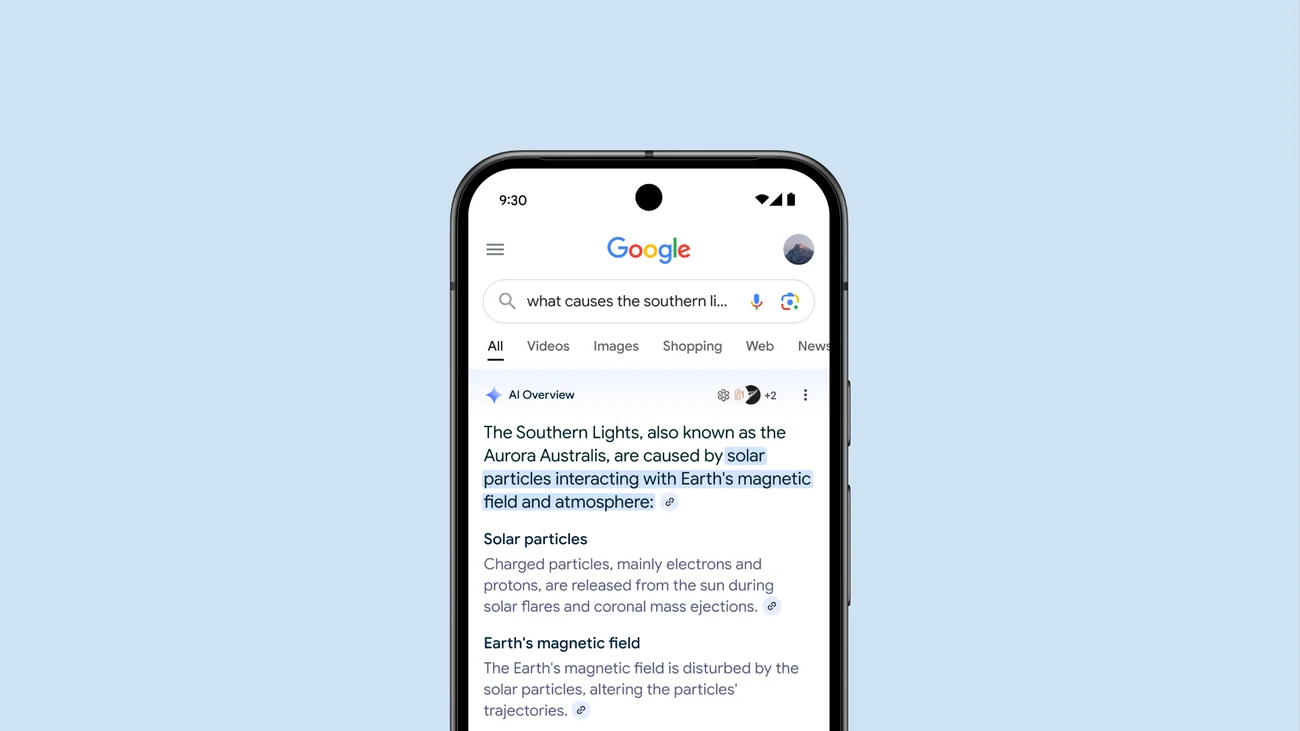
AI systems discover and interpret web content through three separate pathways, each with distinct points of failure:
1. Training Data (Model Weights)
Web pages crawled months earlier are compressed into static model parameters during pre-training.
- Failure mode: The model cites outdated pricing, references discontinued products, or misstates features based on old training scrapes.
- Remediation: Maintain consistent entity records across third-party sources: Wikidata, Crunchbase, official social profiles, and industry directories.
2. RAG and Live Retrieval (Query-Time Lookups)
When a user asks a timely question, answer engines like Perplexity, ChatGPT Search, and Google AI Overviews search the live web, rank candidate passages, and cite top sources.
- Failure mode: Content is rendered via client-side JavaScript that retrieval bots skip, pages lack structured schema, or the text repeats generic definitions without adding factual information.
- Case study (menswear retailer, Double Bay): During a retail audit, an AI assistant was asked whether the menswear retailer's Double Bay store was open. The model stated that the store was closed. The store locator opening hours were rendered exclusively in client-side JavaScript, the retailer used a single national social page rather than location-specific profiles, and the retrieval system failed to ground against local business listings.
- Remediation: Use server-side rendering (SSR), structured Schema.org markup, clear author attribution, and concise factual summaries.
3. Agent Browsing (Autonomous Task Execution)
Autonomous browser agents navigate live sites to extract data, compare items, and complete workflows.
- Failure mode: Dynamic DOM shifts, unstyled modal popups that trap focus, or form controls without accessible names cause agents to fail or exit.
- Case study (Hiking jacket comparison): In a test comparing $300 waterproof hiking jackets, an autonomous browser agent visited a retailer's category page. The product titles loaded, but prices displayed as
$undefinedbecause pricing was fetched asynchronously after the initial paint. When the agent attempted to scroll down, an email subscription popup intercepted the screen. The close button lacked an ARIA label and accessible role. After 18 seconds of failed interaction, the agent exited and chose a competing retailer with accessible markup. - Remediation: Render pricing and inventory server side, add descriptive ARIA labels, and maintain predictable HTML structure.
Different Engines, Different Signals: The Empirical Correlation Data
AI search engines do not share a single ranking algorithm. Correlation data across thousands of queries shows that different platforms prioritise different content attributes. What earns citations in ChatGPT Search differs from what triggers inclusion in Google AI Overviews or Perplexity.
In Suski's 2025 AI Citation Patterns Study (analysing 12,000 AI-cited URLs across ChatGPT Search, Google AI Overviews, Google AI Mode, and Perplexity), correlation coefficients (*r*-values from 0.00 to 1.00) show clear differences across content structure, factual depth, and external authority.
Three Structural Findings from 12,000 Cited Pages
The dataset highlighted three consistent patterns across engines:
- 73% of citations come from the first 500 words: Across all evaluated platforms, nearly three quarters of cited passages came from the first 500 words of the document. Stating the direct answer early increases citation probability.
- Fact coverage correlates with citation: Cited URLs covered an average of 42% of relevant topic facts, compared to 23% for non-cited pages. Factual breadth and detail directly influence retrieval.
- Content depth supports fact coverage: Pages over 2,500 words that maintained factual density achieved higher citation rates across platforms. While raw word count alone is not a ranking factor, comprehensive coverage requires space.
Findings from Academic GEO Research
A 2024 paper from researchers at Princeton, Georgia Tech, IIT Delhi, and AI2 (*GEO: Generative Engine Optimization*, Aggarwal et al., KDD 2024) evaluated specific content adjustments across generative engines:
- Adding statistics and quantitative data: Increased visibility in AI responses by 41%.
- Adding direct expert quotes: Increased citation likelihood by 35% to 40%.
- Citing primary sources: Increased visibility by 115% for lower-ranked domains.
- Keyword stuffing: Decreased visibility below baseline performance.
AI Citation Correlation Matrix
Correlation strength (r-values from 0.00 to 1.00) between content factors and citation frequency across 12,000 AI-cited URLs. Select an engine to reveal platform-specific priorities:
| Optimisation Signal | ChatGPT | Google AIO | AI Mode | Perplexity | Top Engine |
|---|---|---|---|---|---|
StructureEarly Query Confirmation (First 200 Words) | ChatGPT Search (r = .82) | ||||
StructureInter-Section Connectivity & Logical Flow | Google AI Mode (r = .90) | ||||
ContentFact Coverage & Topic Breadth | Google AI Overviews (r = .88) & Perplexity (r = .82) | ||||
AuthorityNamed Author & Verifiable Expertise | Google AI Overviews (r = .75) | ||||
AuthorityExternal Entity Mentions Across the Web | ChatGPT Search (r = .78) |
Early Query Confirmation (First 200 Words)
Peak Impact: ChatGPT Search (r = .82)Why This Signal Matters:
ChatGPT and Google AI Overviews enforce aggressive token window cutoffs during initial retrieval. Stating the direct, factual answer in the first paragraph places your passage firmly within the 73% citation zone.
Recommended Action:
Place the direct answer, primary definition, and core numbers within the first 150 to 200 words of the page.
Of all AI citations come from the first 20% of an article.
Cited URLs cover 42% of topic facts vs 23% for non-cited pages.
Unlinked brand mentions correlate 3× stronger with AI citations than backlinks.
Reading Google and Bing Guidance Objectively
When reviewing public statements from search engines, business incentives matter.
Google's public documentation, including Google Search Central guidance on helpful content and Google's generative search updates, maintains that standard SEO practices remain sufficient for AI features, structured data is optional for AI Overviews, and special formatting is unnecessary.
In contrast, the May 2024 Google Content Warehouse documentation leak (covering 2,596 internal API modules and 14,014 attributes, analysed by iPullRank and SparkToro) showed internal systems not reflected in public statements. The documentation detailed separate scoring components for NavBoost click features, Chrome browsing telemetry, site-level authority metrics, and dedicated evaluation pathways for AI Overviews.
Microsoft Bing and academic researchers take a more direct technical stance:
- Fabrice Canel (Principal Product Manager at Bing): Confirmed in Bing Webmaster announcements that Schema markup directly helps Microsoft LLMs interpret page content.
- Jordi Ribas (Head of Search at Microsoft): Discusses Generative Engine Optimisation (GEO) as a distinct technical discipline.
- Krishna Madhavan (Principal PM at Microsoft AI): Notes that search evaluation is moving from whole documents toward verified, groundable information passages.
- LLM4Schema.org Study (Nantes University / Inria 2025): Documented that major LLMs are trained on Schema.org data, while finding that 40% to 50% of AI-generated schema contains syntax or semantic errors without schema validation.
Google generates substantial ad revenue from traditional multi-link search results, which informs its public advice. Technical planning should account for how retrieval systems actually parse pages.
Public Search Guidance vs. Engineering Reality
Understanding the commercial incentives behind public statements is critical. Compare Google's official public positioning against internal API leaks, Microsoft's engineering architecture, and peer-reviewed academic research:
Google Public Messaging
Search Central & Spokesperson Guidelines"AI search is still just SEO. Structured data is not required for AI Overviews. You do not need llms.txt files."
Downplay divergence to protect traditional ad click monetisation.
Keep webmasters publishing unblocked open-web HTML while preserving Google's $175B+ multi-link SERP advertising model.
Focus solely on "creating helpful, reliable, people-first content" without altering technical formatting for LLM parsers.
Provides zero guidance on passage-level chunking, vector embedding thresholds, or autonomous browser agent discovery.
Google API Leak Reality
Content Warehouse Internal Documentation (May 2024)"Leaked documentation exposes distinct algorithmic pipelines, site-wide authority scoring, and NavBoost click telemetry."
2,596 internal modules reveal complex multi-tiered ranking signals.
Proves that Google operates specialised evaluation pipelines for AI Overviews separate from traditional blue-link organic scoring.
Internal attributes track Chrome browsing click streams, user dwell time, and siteAuthority metrics contrary to public denials.
Passage retrieval heavily references author node entities, verified entity databases, and structured Knowledge Graph vectors.
Microsoft Bing & Research
Bing Webmaster, Microsoft AI & Peer-Reviewed Papers"The unit of value in search is shifting from documents to groundable information. Schema markup directly helps LLMs."
Embrace GEO and explicit semantic grounding as a new discipline.
Explicitly confirmed that Schema.org structured data directly accelerates Microsoft Copilot and Bing LLM comprehension.
Publicly recognises Generative Engine Optimisation (GEO) as an emerging technical practice distinct from classic SERP ranking.
Empirically demonstrated that adding statistics (+41%) and primary source citations (+115%) dramatically boosts AI citations.
The 7-Layer AI-Readiness Framework: Crawl, Comprehend, Convince
To evaluate how well websites handle AI crawlers and agents, I built a 7-layer framework organised around three fundamental questions:
Phase 1: Crawl (Can AI Bots Access the Raw Page?)
- Layer 1: Crawlability and bot access: Check
robots.txtand firewall settings. Define rules for GPTBot, ClaudeBot, PerplexityBot, ChatGPT-User, and Claude-User. Verify that Cloudflare Bot Fight Mode or WAF rules do not block retrieval bots with challenges or 403 errors. - Layer 2: Performance and server-side rendering: Core product data, pricing, and specifications should be present in initial server HTML. Retrieval bots often skip client-side JavaScript execution to save compute. For implementation details, see our technical SEO services.
Phase 2: Comprehend (Can the Model Extract and Interpret the Content?)
- Layer 3: Accessibility and machine readability: Elements that help screen readers also help software agents. Use descriptive alt text, ARIA landmarks, specific link copy ('View enterprise pricing' rather than 'click here'), and accessible form controls.
- Layer 4: Content structure and summary leads: Use a clear heading hierarchy (single H1, followed by H2 and H3 subsections) and eliminate orphan pages. Begin key sections with a concise 40 to 60 word summary that answers the core query directly.
- Layer 5: Structured data and schema: Structured data accounts for 35% of the AI readiness scoring model. Deploy Organization schema with verified
sameAslinks, Article schema with author entities, and Product schema with GTIN, MPN, and return policies. - Layer 6: Factual density over keyword repetition: Structure passages for retrieval and synthesis. Replace keyword repetition with concrete numbers, data points, research citations, and expert quotes.
Phase 3: Convince (Does the Model Trust Your Brand Enough to Cite It?)
- Layer 7: Multi-channel authority signals: In Ahrefs' study of 75,000 brands, unlinked brand mentions showed a 3x higher correlation with AI citations than traditional backlinks. YouTube video mentions had the highest correlation across tested engines, followed by Reddit threads and podcast transcripts. Additionally, 76.1% of URLs cited in AI Overviews also rank in Google's organic top 10, confirming that organic search authority and AI citation visibility support each other.
The 7-Layer AI-Readiness Framework
Structured across three meta-questions: Crawl (Can AI access it?), Comprehend (Can AI understand it?), and Convince (Does AI trust you enough to cite you?).
Crawlability & AI Bot Directives
Core Question: Can AI crawler bots and on-demand retrieval agents access your raw HTML without friction?
Common Failure Mode
Cloudflare Bot Fight Mode or WAF security policies silently block GPTBot, ClaudeBot, PerplexityBot, or ChatGPT-User with 403 Forbidden or JavaScript challenge pages.
Remediation & Action
Explicitly allow verified AI crawler bots and user-triggered retrieval agents in robots.txt. Configure WAF exceptions for verified AI IP ranges.
# Explicit rules for AI crawler bots and user retrieval agents
User-agent: GPTBot
Allow: /

User-agent: ClaudeBot
Allow: /

User-agent: PerplexityBot
Allow: /

User-agent: ChatGPT-User
Allow: /

User-agent: Claude-User
Allow: /Performance & Server-Side Renderability
Core Question: Is your core business value, pricing, and product data delivered directly in the initial HTML payload?
Common Failure Mode
Pricing, inventory, customer reviews, or product specifications require client-side JavaScript execution (CSR). AI retrieval bots skip client JS to conserve token budgets.
Remediation & Action
Implement Server-Side Rendering (SSR) or Static Site Generation (SSG). Ensure 100% of key commercial facts exist in raw view-source HTML.
# Verify raw server HTML contains pricing without executing JavaScript
curl -s -A "ChatGPT-User" https://example.com/product/ | grep -i "price"Accessibility & Machine Overlap
Core Question: Can autonomous browser agents parse your DOM hierarchy and navigate interactive controls?
Common Failure Mode
Buttons without accessible names, generic 'click here' links, modal popups without focus traps or escape keys, and missing form labels cause agents to abort sessions.
Remediation & Action
Align DOM structure with WCAG accessibility principles: descriptive alt text, ARIA landmarks, semantic button/link tags, and contextual anchor text.
<!-- Ambiguous (Fails Agent Navigation) -->
<a href="/pricing">Click here</a>

<!-- Descriptive & Machine-Actionable -->
<a href="/pricing" aria-label="View Enterprise SEO Consulting pricing tiers">
  View Enterprise SEO Consulting Pricing
</a>Content Architecture & Lead Summaries
Core Question: Is your content structured into self-contained semantic passages that can be extracted cleanly?
Common Failure Mode
Disorganised headings (H3 before H2, multiple H1s), orphan pages lacking cluster links, and answers buried in paragraph 7 after conversational fluff.
Remediation & Action
Follow strict H1 > H2 > H3 nesting. Lead every section with a direct, factual 40 to 60 word summary paragraph suitable for direct LLM passage citation.
## [Topic / Question Heading]

**Direct Summary Lead (First 200 Words):**
[Direct factual answer stating the definition, core metric, or resolution in 45 words.]

[Supporting evidence, empirical data, methodology, and case studies follow below.]Structured Data & Entity Schema Graph
Core Question: Does your site expose validated JSON-LD schema linking entities to authoritative knowledge graphs?
Common Failure Mode
Missing Organization schema, unverified sameAs arrays, articles lacking named author entities, or eCommerce products missing GTIN/MPN and return policy attributes.
Remediation & Action
Deploy connected JSON-LD graphs linking Organization sameAs nodes (Wikidata, Crunchbase, LinkedIn) with Article, Person, and Product schemas.
{
  "@context": "https://schema.org",
  "@type": "Person",
  "@id": "https://rahulsengupta.digital/#person",
  "name": "Rahul Sengupta",
  "jobTitle": "SEO & AI Search Consultant",
  "sameAs": [
    "https://www.linkedin.com/in/rahul-sengupta/",
    "https://github.com/rahulsengupta"
  ]
}Clarity Over Keywords (Information Density)
Core Question: Does your copy provide high factual density, statistics, and verifiable expert quotes over keyword repetition?
Common Failure Mode
Thin AI-generated fluff repeating target keywords without providing net-new facts, statistics, or original research.
Remediation & Action
Optimise for information gain. Include empirical numbers, verifiable data points, primary source links, and clear expert attribution.
Princeton GEO Study Finding:
• Adding specific statistics & quantitative data: +41% AI citation visibility
• Incorporating verified expert quotes: +35% to +40% citation likelihood
• Citing authoritative primary sources: +115% visibility for lower-ranked domainsAuthority & Multi-Channel Entity Signals
Core Question: Does the broader web validate your brand across non-traditional channels (YouTube, Reddit, podcasts)?
Common Failure Mode
Relying solely on traditional backlink building while remaining completely absent from discussions on Reddit, industry podcasts, and YouTube transcripts.
Remediation & Action
Build cross-channel brand mentions. Ahrefs' 75k brand study shows unlinked brand mentions correlate 3× stronger with AI citations than backlinks.
Ahrefs Correlation Data (75k Brands):
• YouTube Brand Mentions (transcripts/titles): Highest single correlation
• Unlinked Web Brand Mentions: r = 0.664 (vs Backlinks r = 0.218)
• Top 10 Google Organic Overlap: 76.1% of AI-cited URLs rank in Google Top 10Calculate Your Website's AI-Readiness Score
Check off the technical requirements your digital ecosystem currently meets to calculate your AI access score.
Audit Your Domain
Select the items you have verified above to compute your live AI retrieval score and access readiness tier.
Emerging Protocols and Standards for 2026
As browsing agents become more capable, three emerging specifications help sites interact with automated visitors:
1. Universal Commerce Protocol (UCP)
The Universal Commerce Protocol provides an open REST and JSON format for AI agents to query ecommerce endpoints directly:
{
  "ucp": {
    "version": "2026-01-11",
    "services": {
      "dev.ucp.shopping": {
        "rest": {
          "endpoint": "https://brand.example.com/api/agent/v1"
        }
      }
    },
    "capabilities": [
      "checkout",
      "discount",
      "fulfillment",
      "inventory_check"
    ]
  }
}
2. WebMCP (Web Model Context Protocol)
Introduced in August 2025 by engineers at Microsoft and Google (Brandon Walderman, Leo Lee, David Bokan, Khushal Sagar), WebMCP allows web applications to expose structured JavaScript tools within the browser. Rather than relying solely on visual screenshot analysis, browser assistants interact with application state through defined tool definitions.
3. Machine Discovery Endpoints: llms.txt and Agentic Sitemaps
In May 2026, Shopify introduced default /llms.txt and /sitemap_agentic_discovery.xml endpoints across its platform. Customising these files allows you to guide AI retrieval bots directly toward your primary documentation, product indexes, and authoritative research.
Five Practical Actions You Can Execute This Week
Improving your site for AI retrieval does not require a complete rebuild. Here are five practical steps to start with:
- Review crawler permissions in robots.txt: Check your
robots.txtfile and firewall settings to ensure GPTBot, ClaudeBot, PerplexityBot, ChatGPT-User, and Claude-User can access your content without unexpected blocks. - Place key answers early in the page: Review your highest-traffic pages. Put the direct answer, primary definition, and core numbers in the first 200 words, where models extract the majority of citations.
- Add structured entity schema: Add Organization schema with verified
sameAslinks to Wikipedia, Crunchbase, and official profiles. Ensure articles include named author markup with verifiable credentials. Learn more on my about page. - Benchmark your visibility across engines: Run your top 20 commercial queries through Google, ChatGPT Search, and Perplexity to see where your brand is cited and where competitors appear.
- Include primary source citations: Link directly to relevant research, benchmarks, and data sources. Citing authoritative studies improved citation frequency by up to 115% in academic testing.
Empirical Evidence & Citation Studies
All strategies in this guide are grounded in verifiable research datasets, academic benchmarking, and large-scale web crawler access logs. Explore the underlying studies:
AI Brand Visibility Factors Across 75,000 Brands
Unlinked brand web mentions correlate 3× more strongly with AI citations than traditional backlinks (r = 0.664 vs r = 0.218). YouTube video mentions exhibit the single highest multi-platform correlation.
AI Overview Citations and Google Top 10 Overlap
76.1% of URLs cited in Google AI Overviews also rank in Google's organic top 10 search results, demonstrating that strong classic SEO authority compounds directly into AI search visibility.
GEO: Generative Engine Optimization
Adding quantitative statistics (+41%), incorporating verified expert quotes (+35–40%), and citing primary authoritative sources (+115%) dramatically increases citation probability. Keyword stuffing lowers visibility below baseline.
AI Citation Patterns & Fact Coverage Study
73% of extracted AI citations originate from the first 500 words (the first 20%) of the document. Cited pages covered an average of 42% of relevant topic facts versus 23% for non-cited URLs.
Global Bot Traffic & AI Crawler Surge Report
Non-human bot traffic officially outpaced human visitors (51% vs 49%). GPTBot crawl requests grew +305% YoY and ChatGPT-User on-demand fetches surged +2,825%.
State of AI Traffic and Cyberthreat Benchmark
77.0% of autonomous agent actions occur on product and search pages, with 2.3% executing direct commercial checkout flows without human intervention.